Lock Maintenance for Facilities: A Simple Program
Updated October 9, 2026
If you look after a building full of doors, lubricate locks on a schedule instead of waiting for someone to report one. By the time a lock gets reported, it is usually stiff enough that people are forcing keys, and a forced key is how you end up with a broken key in a cylinder and a door nobody can open.
Why a schedule beats waiting for complaints
Locks fail gradually. A cylinder gets a little gritty, then a key needs jiggling, then one morning it will not turn at all. Most people do not report the first two stages. They work around them, and the workaround is usually more force.
A stuck lock on an exterior door in winter becomes a lockout. A key snapped off in a cylinder means a locksmith call and a door out of service until they arrive. On exit hardware, a panic bar that sticks or a door that does not latch is a safety problem, and it is the kind of thing that gets written up during fire code inspections.
A scheduled pass catches the gritty stage, which takes a few minutes per door to fix.
What a simple program looks like
It does not need software. A spreadsheet and a stocked cart will do.
- Inventory the doors. Give each one an ID that matches your floor plans, and note the hardware: lockset, deadbolt, exit device, closer, and whether it is a fire-rated door.
- Rank them. Exterior doors come first, because weather and grit get to them. Then high-traffic interior doors, then life-safety hardware such as exit devices and stairwell doors. Storage rooms and offices that get locked once a day go last.
- Set the frequency. Exterior and high-traffic doors get looked at more often than a records room. Adjust based on what you find: if a door is gritty every time, shorten its interval.
- Do a pass before winter. Every exterior lock, gate padlock, roof hatch and outbuilding door gets lubricated in the fall, before the first freeze. Winterizing your locks covers what cold does to a cylinder.
- Keep a log. Door ID, date, who did it, what was done, and anything that needs follow-up. When a lock fails later, the log tells you whether it was being looked after or missed.
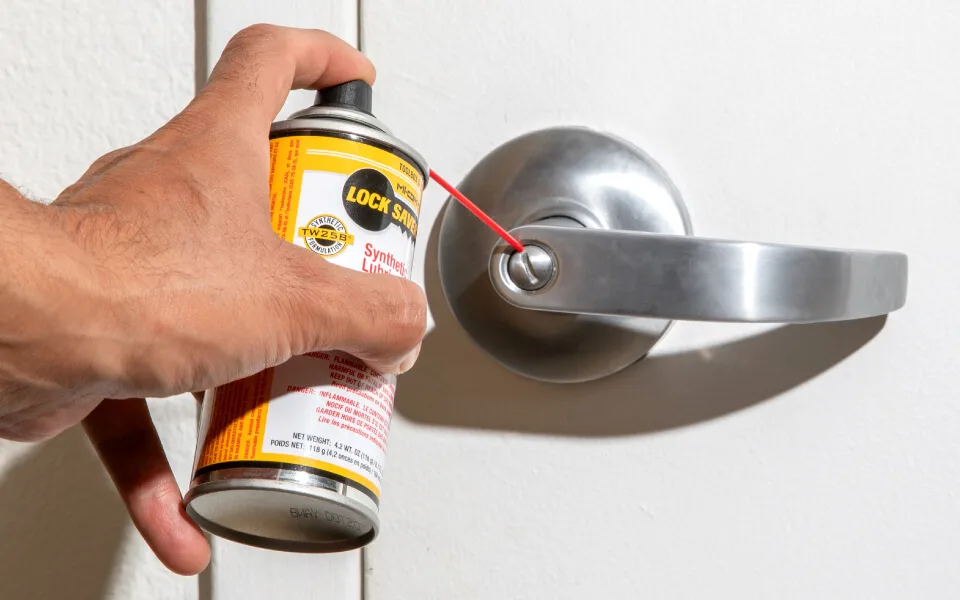
At each door the routine is the same: spray into the keyway, cycle the key several times, spray the latch and deadbolt with the door open, work the handle, check that the door latches on its own, and wipe off the excess. The full method is in how to apply lock lubricant correctly.
What to put in the maintenance cart
- A lock lubricant that leaves a dry film. Wet oils collect grit in a keyway, and graphite powder can cake when it gets damp, which is a problem on any exterior door. Lock Saver leaves a semi-dry film and does not gum up, and the extension straw reaches into keyways and latch pockets.
- Clean rags, and a can of compressed air for blowing dirt out of keyways first.
- Screwdrivers and the bits your hardware uses, for loose strike plates and hinge screws.
- A few longer screws for re-securing loose hinges and strikes.
- Gloves and eye protection.
- The log, on paper or a tablet.
Aerosols are flammable and under pressure, so store them according to your site’s rules for flammable products and do not leave cans in a hot vehicle.
When to call a locksmith
Lubrication fixes dry and dirty hardware. It does not fix worn or broken parts. Call a locksmith when:
- the key turns but the bolt does not move,
- the cylinder spins in the door,
- a key has broken off inside,
- keys only work when held at an angle (often worn keys or a worn cylinder),
- an exit device or a fire door still will not latch after lubrication and screw tightening,
- the door has electrified hardware such as an electric strike, a magnetic lock or an access control reader.
Fire-rated doors and their hardware should be repaired by someone qualified to work on them. Your team can clean and lubricate, but replacement parts and adjustments to that hardware belong with a locksmith or the hardware supplier.
Keep the SDS on file
Whatever products your team uses, keep the safety data sheet where staff can find it. The Lock Saver safety data sheet is on our SDS page.
Ordering for a building
Lock Saver comes in a 12.65 fl oz (380 mL) can for the cart and a 4.2 oz toolbox can that fits in a technician’s tool bag. The label is bilingual English and French, which matters for teams in Canada. For case and bulk orders, see commercial orders; a team that does a full pre-winter pass on every exterior door will know by spring how many cans a year the building actually uses.