The Science Behind Lubricants: How They Reduce Friction
Updated October 9, 2026
A lubricant reduces friction by putting a thin film between two surfaces so they stop touching directly. Less contact means less resistance, less heat and less wear. Everything else about how lubricants work is detail on that one idea.
What is a Lubricant?
A lubricant is any substance that sits between two surfaces in contact and lowers the friction between them when they move. Oils, greases, dry films such as graphite or PTFE, and synthetic blends all qualify. They differ in how thick the film is, how long it stays put and what conditions it tolerates.
Why Surfaces Create Friction
Even polished metal is rough at a microscopic scale. When two parts meet, they touch only at the high points of those surfaces, called asperities. Under load, those points press together, catch and shear as the parts slide. That catching and shearing is most of what we feel as friction, and it is also where wear and heat come from.
How Lubrication Reduces Friction
A lubricant fills the low spots and coats the high ones, so the moving surfaces ride on the lubricant instead of on each other. The lubricant itself shears easily, so sliding takes far less force. Less rubbing also means less heat and less metal worn away.
How Lubricants Reduce Friction in Practice
Engineers describe three regimes, depending on how thick the film is compared with the roughness of the surfaces:
- Boundary lubrication. The film is only a few molecules thick and the high points still touch. Additives or dry films that bond to the metal do the work here. Slow, high-load, stop-start motion lives in this regime, and so do most locks.
- Mixed lubrication. Part of the load rides on the film and part on surface contact. Many parts pass through it every time they start or stop.
- Hydrodynamic (full film) lubrication. Motion drags enough fluid between the surfaces to separate them completely. Spinning shafts in oil-fed bearings work this way, and friction drops sharply.
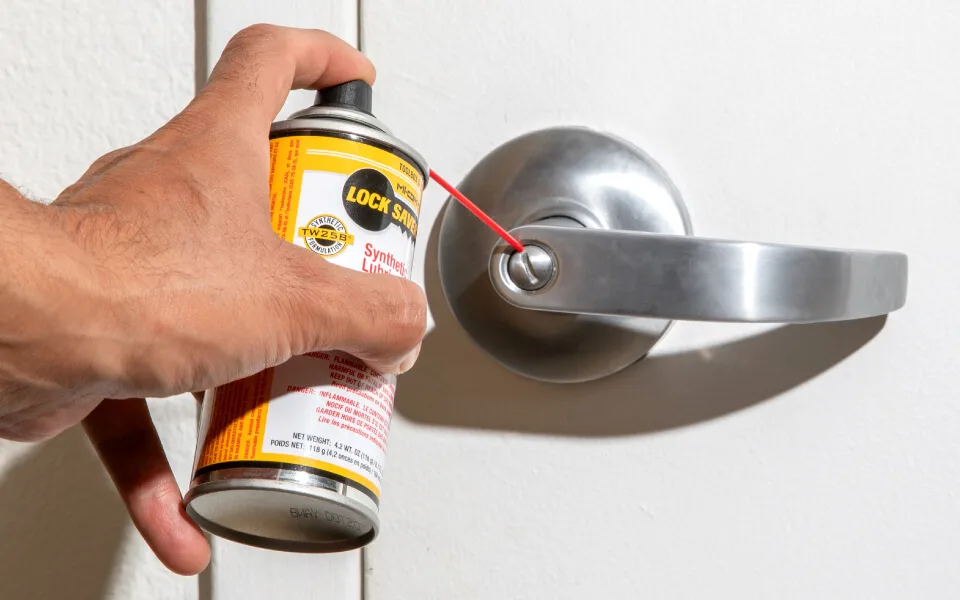
This is why one lubricant does not suit every job. An engine needs a fluid that builds a full film at speed. A lock pin moves a fraction of an inch a few times a day, and needs a film that stays on the metal between uses without collecting grit.
Types of Lubricants and Their Uses
1. Oils
Liquid lubricants made from a base oil plus additives. Engine oil also cleans, cools and neutralizes acids. Hydraulic oil transmits power as well as lubricating. Light oils penetrate tight spaces but stay wet, so they can hold on to dust.
2. Greases
Oil held in a thickener so it stays where it is put. Greases suit bearings, gears and slides that need lubricant to stay in place under load, but they are too heavy for the small, tight parts inside a lock cylinder.
3. Dry Films and Synthetics
Graphite, PTFE and synthetic formulations that leave a thin coating rather than a wet layer. These work well in boundary conditions and where dirt is a problem. Lock Saver, made with MIL-COMM’s TW25B synthetic formulation, leaves a semi-dry protective film for this reason.
Choosing the Right Lubricant
Match the lubricant to the motion, the load, the temperature and the environment, and check what the equipment’s manufacturer specifies. For locks and hardware, see the types of lock lubricant compared and how to lubricate a lock step by step.